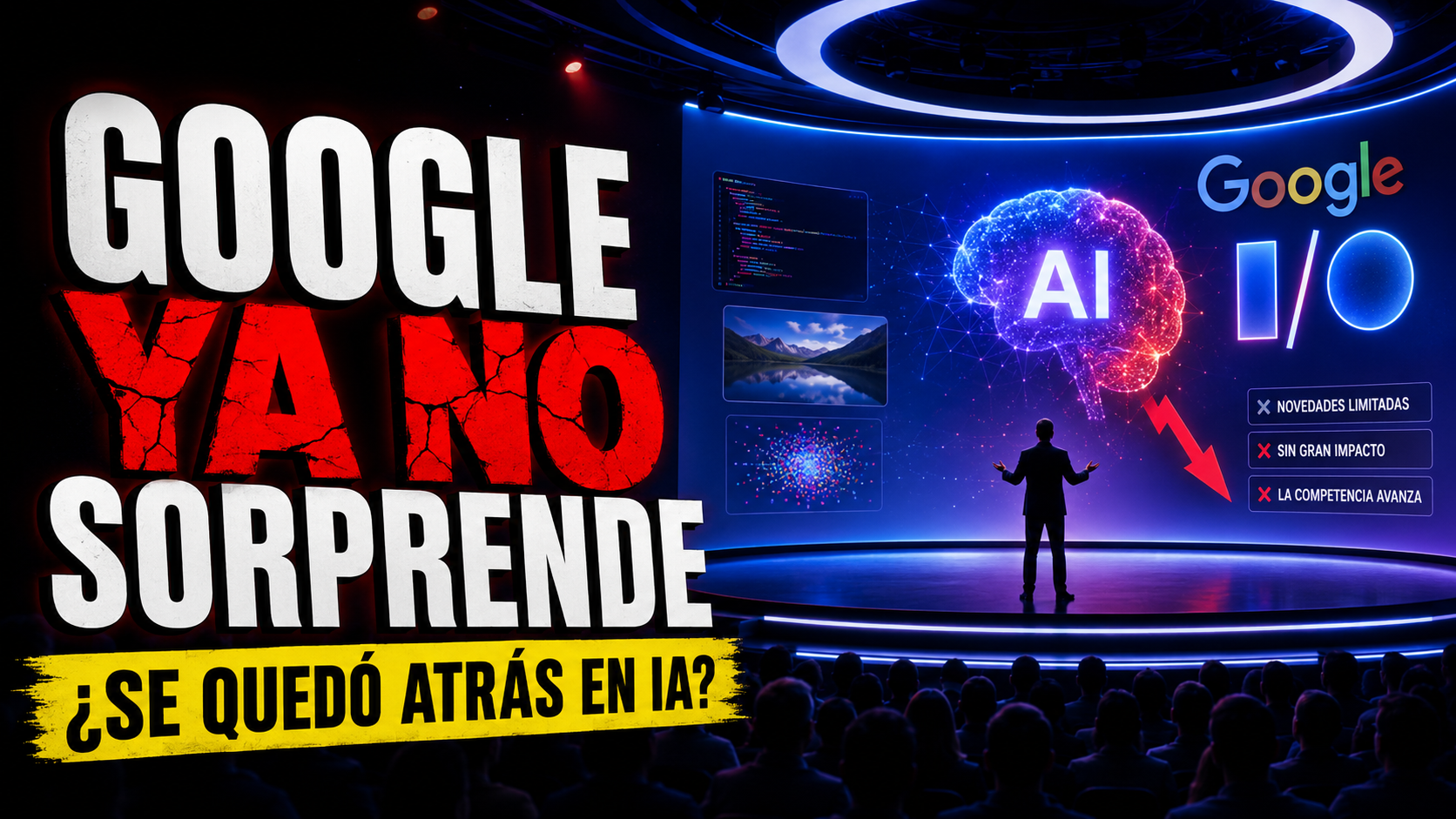
Google I/O: Competitive, but no longer surprising
Analysis of Google I/O: the company remains competitive in artificial intelligence with Gemini, but its announcements no longer manage to surprise.
Koween · May 19, 2026
After several months of waiting, Google finally held a new edition of Google I/O, the event where it usually presents its biggest innovations of the year in areas such as artificial intelligence, operating systems, and its various platforms.
Since generative AI and LLMs gained popularity, this event has become a particularly anticipated date for tech enthusiasts. Google is not only one of the most important companies in the sector, but also one that historically has set the direction for many of the technologies we use daily today. Because of this, every Google I/O comes with a unique expectation: the idea that Google can surprise us once again.
However, this year the feeling was different.
If we focus solely on artificial intelligence, last year's Google I/O was undoubtedly one of the company's most interesting events in a long time. This year's, by contrast, felt far more uneven. It wasn't a bad event by any means, but it did fall short of expectations.
Following OpenAI's recent advancements with ChatGPT 5.5 and the evolution of its image generation models, many people expected a strong response from Google. They anticipated not only a smarter model, but also image, video, and code generation tools that would stand out clearly from what is already on the market.
And while Google introduced several relevant innovations, the overall feeling was bittersweet. The company remains competitive, but it no longer seems to be surprising at the pace many expected.
Among all the announcements, there are three that I consider the most important: Gemini Omni, Google Antigravity 2.0, and Gemini 3.5 Flash. Each represents a different bet within Google's ecosystem, but they also reveal some of the doubts currently surrounding the company in the field of AI.
Gemini Omni: a lot of potential, uneven results
Gemini Omni was introduced as a multimodal model focused on making video editing easier through natural language. According to Google, the tool promises a high level of character and scene consistency, realistic physics, and a much simpler workflow for tasks that until recently required specialized software and hours of manual editing.
On paper, the proposal is very powerful. A tool capable of editing video using natural language instructions could have a massive impact on the creative industry, especially in areas like VFX, advertising, social media content, and independent audiovisual production.
The problem is that, at least for now, the execution does not seem to fully live up to the promise.
In my tests, Gemini Omni showed interesting, creative, and even visually appealing results at certain points. However, it also displayed significant inconsistencies. Character, scene, and detail consistency still fails frequently, and the model tends to make its own decisions regarding camera cuts, composition, or visual changes that were not requested.
This doesn't mean the tool is bad. On the contrary, it has massive potential. But it does make it clear that we are still looking at a developing technology, closer to a compelling promise than a fully reliable solution for professional workflows.
This is where the difference between the examples shown by Google and the actual results obtained by users becomes particularly important. Official demonstrations usually showcase the best possible scenario, but practical experience still reveals limitations that are hard to ignore.
Google Antigravity 2.0: more agent, less editor
Another significant announcement was Google Antigravity 2.0, the new version of the AI-powered code editor. This time, Google seems to have leaned more heavily into an agent-centric experience, prioritizing interaction with the AI over the traditional workflow of writing and reviewing code.
The most obvious change is in the interface. Google Antigravity 2.0 moves away from the classic structure of a code editor and closer to an agent-first experience, where the AI plays a central role in the development process.
The idea makes sense. More and more programming tools are trying to turn AI models into active collaborators capable of writing, modifying, reviewing, and executing complex tasks within a project. However, this transition also carries certain risks.
One of the most debatable points is the removal or reduced visibility of traditional elements like the file explorer and text editor. For developers who enjoy reviewing their code line by line, understanding the project structure, and maintaining direct control over changes, this approach can feel too aggressive.
Google seems to want to push AI-assisted development toward a more automated experience, but not all users want to delegate that much control. In that sense, Antigravity 2.0 might be interesting for those looking for speed and automation, but less appealing for those who still value a more manual and precise relationship with their code.
Furthermore, it is hard to ignore that the tool seems to have drawn significant inspiration from Codex. This is not necessarily a bad thing; all tools in the industry are influencing one another. But it does leave the impression that Antigravity is losing part of its personality along the way, risking looking more like a response to OpenAI than Google's own distinct vision.
Gemini 3.5 Flash: more capable, but also more expensive
The third announcement I consider particularly important is Gemini 3.5 Flash. Google presented it as a next-generation Flash model: faster, cheaper, and, according to the company, even smarter than Gemini 3.1 Pro.
In principle, this sounds like great news. A faster, cheaper, and more capable model could be exactly what many users need, especially those using AI for programming, automation, or token-heavy tasks.
But an uncomfortable question arises here: what does "cheaper" actually mean?
In recent months, we have seen major companies increasingly reduce the amount of available tokens in coding sessions, limit heavy usage of their best models, and push users toward more expensive plans. In this context, the pricing of Gemini 3.5 Flash is concerning, as it seems to sit much closer to Gemini 3.1 Pro than to its direct predecessor, Gemini 3.1 Flash.
This opens up a broader discussion about the future of frontier AI. If "budget" models begin to increasingly approach the pricing of previous premium models, then access to great AI tools could become less and less democratic.
For years, there has been talk about the democratization of artificial intelligence, but market realities seem to be moving in another direction. The best experience usually lies behind stricter limits, more expensive subscriptions, and models that are increasingly costly to use heavily.
Gemini 3.5 Flash may be a great model, but it also represents a worrying trend: the possibility that truly competitive AI becomes a luxury for those who can afford it.
Gemini 3.5 Pro: the announcement that wasn't an announcement
It is also worth mentioning Gemini 3.5 Pro, though more as an absence than an actual novelty. Google confirmed that the model would arrive soon, but offered no concrete details regarding its capabilities, performance, or differences from the current generation.
Therefore, it is hard to consider it a relevant announcement. More than a presentation, it was a promise. And at an event where many expected a strong response from Google, a promise without much information is not enough to generate excitement.
Google keeps competing, but no longer sets the pace
The final takeaway from this Google I/O is not that of a lagging company. Google still has talent, infrastructure, products, competitive models, and a massive ecosystem from which to drive its AI advancements.
The problem is something else: Google no longer surprises like it used to.
Its announcements are interesting, but not necessarily exciting. Its tools have potential, but often seem to come with significant limitations. Its models remain competitive, but they no longer clearly convey that feeling of being several steps ahead of the rest.
Perhaps part of the problem comes from expectations. The community expected too much. Following OpenAI's recent progress and the speed at which the industry is moving, many expected Google to respond with something truly monumental. Instead, the company delivered solid improvements, but not a definitive statement.
And that is, perhaps, the best way to summarize this event: Google did not live up to expectations. It remains competitive, continues to make progress, and continues to hold a central role in the future of artificial intelligence. But, at least for now, it no longer surprises.